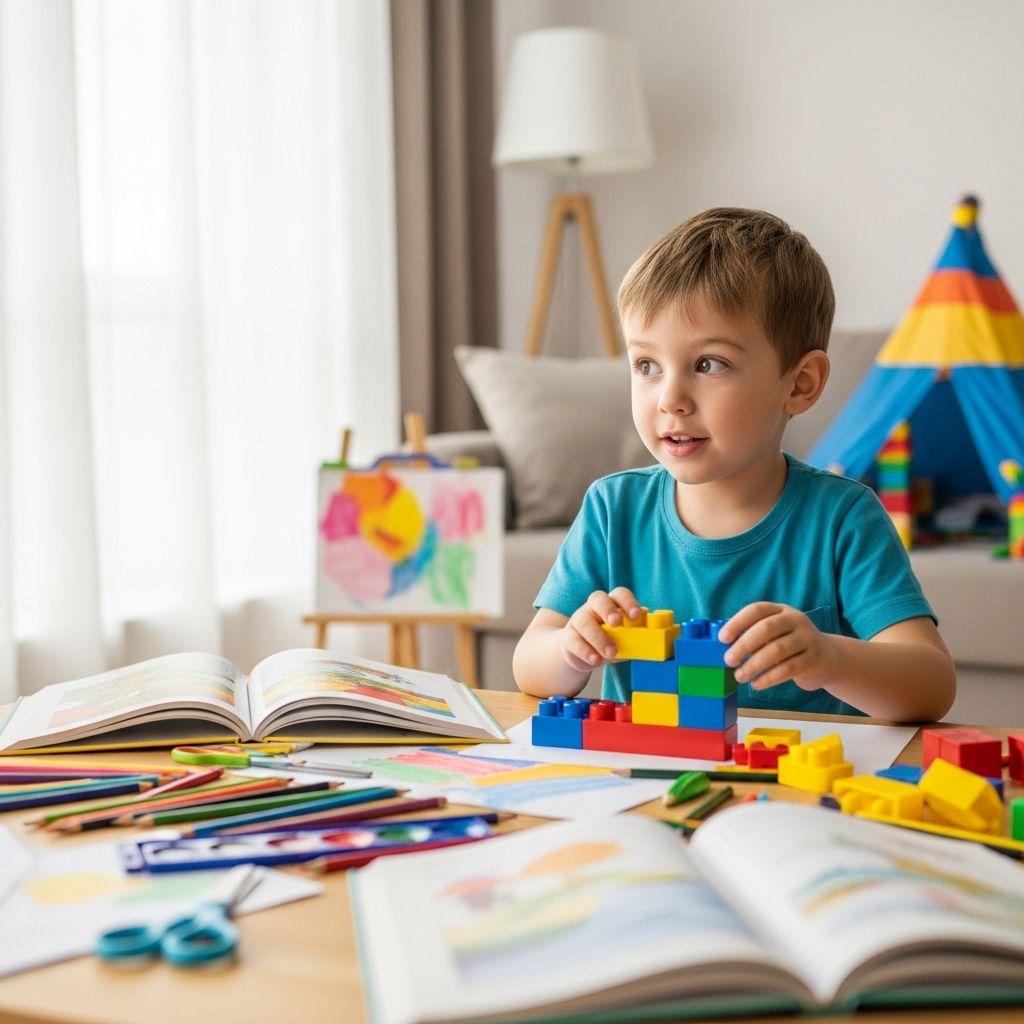
Four-year-olds are curious, energetic, and full of ideas. The right at-home activities channel that energy into play that builds language, movement, problem-solving, and confidence—all while keeping the day fun for both of you.
Understanding Your 4-Year-Old’s Play Needs
At four, children are starting to tell simple stories, follow multi-step directions, and play cooperatively with friends or siblings. They are also refining small hand movements, developing stronger balance, and practicing emotional skills like taking turns and coping with frustration. Thoughtfully chosen activities can support all of these areas without feeling like “lessons.”
Instead of aiming for perfect crafts or rigid routines, focus on open-ended play. Give your child time, simple materials, and a bit of structure, then step back and let them explore. The ideas below are organized by type of learning so you can mix and match throughout the week.
Quick Planning Guide for Busy Caregivers
If you only have a few minutes to plan, use this guide as a starting point. Choose one idea from each row in the table and you have a well-rounded day of play without overthinking it.
| Goal | Fast Activity Idea | Typical Time |
|---|---|---|
| Burn off energy | Indoor movement trail with pillows and tape lines | 10–20 minutes |
| Practice early literacy | Letter treasure hunt with sticky notes | 10–15 minutes |
| Build fine motor skills | Cutting and gluing a “silly collage” | 15–25 minutes |
| Encourage imagination | Pretend “grocery store” with pantry items | 20–30 minutes |
| Wind-down time | Story basket with a book and related toys | 10–20 minutes |
Big-Movement Play in Small Spaces
Four-year-olds often need to move before they can settle into quieter activities. Indoor movement games don’t require a lot of space—just a bit of furniture rearranging and a playful attitude.
1. Living-Room Adventure Path
Create a safe “adventure path” that your child can follow around the room. This activity supports balance, coordination, and listening skills.
- Place pillows, blankets, and tape lines on the floor as stepping stones, tunnels, or “rivers” to jump over.
- Give simple instructions, such as “Walk on the line, hop to the pillow, crawl under the table, then high-five the door.”
- Invite your child to redesign the path and become the “guide,” giving you directions in return.
2. Color-Match Movement Game
This game combines movement, color recognition, and basic self-control.
- Place colored papers or pieces of fabric in different corners of the room.
- Call out prompts such as “Touch something red while walking like a crab” or “Jump to blue on one foot.”
- Let your child invent new moves and color combinations to lead the game.
Creative Projects with Everyday Materials
You don’t need fancy supplies to support creativity. Recycled boxes, paper, and basic art materials become powerful tools for storytelling, design, and early problem-solving.
3. Cardboard City Builders
Turn boxes and packaging into a miniature town. This long-lasting project can stay out for several days and grow over time.
- Gather clean boxes, paper tubes, bottle caps, and scraps of cardboard.
- Help your child decide what to build: houses, a fire station, a park, or a train station.
- Use tape, markers, and crayons to add doors, windows, roads, and signs your child “writes” or scribbles.
- Bring in toy vehicles or figures and see what stories unfold in your new city.
4. Texture Art Exploration
This project encourages sensory exploration and language growth as you talk about how things feel.
- Offer glue, a piece of sturdy paper, and a tray of materials with different textures: cotton balls, dry pasta, fabric scraps, foil, or leaves.
- Invite your child to create a “bumpy” or “soft” picture, describing each item as they glue it down.
- When the collage is dry, run fingers over it together and talk about rough, smooth, prickly, squishy, and other words.
Early Literacy Through Play
Reading and writing at four should feel playful and relaxed. The aim is to build curiosity about words and letters, not to push formal academics before your child is ready.
5. Letter Treasure Hunt
Hide letters around your home to turn early literacy into a game.
- Write individual letters on sticky notes or small pieces of paper.
- Hide them in easy-to-spot places and give your child a basket or bag to collect them.
- Each time they find a letter, say its name and the sound it usually makes. If they are interested, ask, “Can you think of a word that starts with this sound?”
6. Family Name Lab
Many four-year-olds are fascinated by their own name and the names of people they love. Use that interest to introduce letters and beginning writing.
- Write the names of family members on index cards or strips of paper.
- Invite your child to match the names to photos or drawings of each person.
- Offer crayons or markers so they can trace over the letters or try writing the first letter themselves.
Playful Math and Problem-Solving
Everyday objects are perfect tools for introducing counting, comparing sizes, and simple patterns. Short, informal math games help your child build comfort with numbers long before homework appears.
7. Snack Sorting Station
Turn snack time into a mini math lab that is still firmly focused on enjoying food.
- Give your child a small pile of snack items such as crackers, berries, or cereal pieces.
- Ask them to sort by color, shape, or type and count how many are in each group.
- Talk casually about “more,” “less,” and “the same,” keeping the tone light and playful.
8. Pattern Train Game
This activity builds early algebra skills through pattern recognition and prediction.
- Line up small toys, blocks, or buttons in a simple color or shape pattern such as red-blue-red-blue.
- Ask your child, “What comes next?” and invite them to continue the pattern.
- Once they understand, let them design a pattern train for you to complete.
Imagination and Role-Play Scenarios
Pretend play is how many four-year-olds make sense of the world. Through role-play, they practice social skills, emotional expression, and language in a low-pressure way.
9. Home Helper Play
Many children love imitating adults. Turn everyday chores into pretend games rather than battles.
- Set up a small “cleaning kit” with a spray bottle of water, cloth, and mini broom.
- Invite your child to “rescue” toy animals from dusty shelves or to polish a pretend restaurant before opening time.
- Offer small, real responsibilities—such as matching socks or wiping a low table—to build independence.
10. Neighborhood Shop or Café
Transform a corner of your home into a store, bakery, or café that evolves over several days.
- Use empty boxes, pantry items, or toy food to stock shelves or a counter.
- Create simple price tags using dots or small numbers and pretend money with paper circles.
- Take turns being the customer and the shopkeeper, encouraging polite greetings, simple counting, and problem-solving (“We are out of apples—what else can you choose?”).
Calm Time, Sensory Play, and Reset Moments
Active play is important, but so is learning to slow down. Calm activities give your child tools to handle big feelings and transitions, which is especially helpful before naps, bedtime, or after a busy outing.
11. Story Basket Quiet Time
A story basket turns reading into a full-body experience and works well when your child is too wiggly to sit still with just a book.
- Place a favorite book in a basket with a few related items, such as toy animals, blocks, or household objects from the story’s setting.
- Read a few pages, then pause so your child can act out what is happening using the items in the basket.
- Let them “retell” the story afterward, even if the events don’t exactly match the book.
12. DIY Sensory Tray
This simple setup can be reused all week with small variations.
- Fill a shallow container with a base material such as dry rice, lentils, or water.
- Add scoops, spoons, funnels, and a few small toys.
- Stay nearby while your child explores pouring, burying, and digging, narrating what you see: “You filled the cup all the way. Now you’re pouring it slowly into the bowl.”
Simple Daily Rhythm for At-Home Play
A loose rhythm helps many children feel secure without needing a strict schedule. Think of your day in broad blocks instead of watching the clock.
- Morning: Movement activity, followed by a short literacy or math game.
- Midday: Creative project or pretend play, then lunch and rest time.
- Afternoon: Outdoor time if possible, plus a sensory or calm-down activity before dinner.
Repeat favorite activities for several days rather than reinventing everything daily. Four-year-olds often enjoy mastering the same game again and again with small twists.
Frequently Asked Questions About At-Home Activities for 4-Year-Olds
How long should my 4-year-old stay with one activity?
Attention spans vary, but many four-year-olds engage for around 10–20 minutes when an activity is well-matched to their interests. If they drift away sooner, that usually means the task is too easy, too hard, or they simply need a movement break.
Instead of forcing them to finish, invite them to help you “save” the activity for later. Leaving projects partially set up makes it easy for your child to return when curiosity comes back.
Do these activities replace preschool?
Home activities can support many of the same skills that preschool develops—language, early math, fine motor control, and social practice—but they do not need to mirror a classroom day. Young children learn best through play, conversation, and real-life experiences with caring adults.
If your child attends preschool, use these ideas to extend their interests at home without turning evenings into more “school.” If they are not in a formal program, a few playful activities each day plus plenty of free play is already valuable.
What if my child only wants screens?
Many families use screens, and occasional screen time doesn’t cancel out the benefits of offline play. Rather than battling outright, gently limit access by creating appealing alternatives and clear routines.
- Offer screen time at predictable times, such as after lunch, and stick to those boundaries as calmly as possible.
- Before turning a device off, give warnings and have a next activity ready, like a sensory tray or movement game.
- Invite your child to act out scenes or characters from a favorite show through pretend play, bridging their interests into real-world activities.
How can I manage activities with more than one child?
Choose setups that can be easily scaled up or down. Sensory trays, building activities, and pretend shops work well for mixed ages because each child can participate at their own level.
When possible, give older children small “helper” roles—such as hiding letters for the treasure hunt or designing the adventure path—so they feel included rather than interrupted by their younger sibling’s activities.
What if I am not a “crafty” or “playful” parent?
Your child values your presence and attention more than perfectly executed activities. Choose one or two simple ideas that feel manageable and repeat them in different ways.
Even short bursts of connection—ten minutes of full-focus play, followed by independent time—can make the whole day feel smoother for both of you.
Supporting your 4-year-old’s growth at home does not require complicated plans or expensive materials. With a few flexible activities and a willingness to follow your child’s curiosity, your home can become a rich, playful learning environment.