The 100th day of school has become a joyful milestone in many elementary classrooms, marking persistence, growth, and the simple fact that your child has shown up and learned for one hundred days straight. As a parent, this celebration can feel both exciting and overwhelming, especially when a project is involved. This guide offers original, practical ideas to help you create a project that is meaningful, age-appropriate, and stress-free.
Why the 100th Day Matters to Kids
For young children, the number 100 feels huge and almost magical. Turning that number into something they can touch, count, and show off gives them a sense of accomplishment. A well-chosen project can reinforce counting, grouping, and early math skills while building confidence and pride in their work.
Beyond academics, celebrating the 100th day encourages kids to reflect on how much they have grown since the first day of school. It becomes a moment to recognize progress, perseverance, and the idea that small efforts add up over time.
How to Choose the Right Project for Your Child
Not every 100th day of school project fits every child or every household. The best project is one that works with your schedule, your budget, and your child’s interests and abilities. Rather than striving to impress others, focus on helping your child understand and enjoy the process.
Use these simple questions as a starting point when you decide what to create together:
- How much time realistically do we have before the project is due?
- What supplies are already in our home that we can use?
- What does my child love right now (animals, sports, nature, art, superheroes)?
- Can my child complete most of the work independently, with light guidance?
- Will this project allow my child to proudly explain the “100” connection?
Planning Ahead: A Simple Parent Timeline
Even a small project feels big when you start the night before. Giving yourself and your child a short, realistic mini-plan can prevent tears and last-minute store runs. This simple planning approach turns a looming assignment into a manageable family activity.
Here is a suggested timeline you can adapt to your family’s schedule:
| Timeframe | Parent Action | Child Action |
|---|---|---|
| 5–7 days before | Read the teacher’s instructions and note any rules (size, no food, due date). | Share ideas about favorite themes, colors, or objects. |
| 3–4 days before | Gather supplies from home; buy only what is missing. | Sketch or talk through what the finished project might look like. |
| 2 days before | Help set up a workspace and protect surfaces. | Start arranging, counting, or gluing some of the 100 items. |
| 1 day before | Double-check that the project is sturdy, labeled, and dry. | Add final decorations, labels, or drawings. |
| Morning of | Help transport the project safely to school. | Practice a short explanation of the project. |
Low-Stress Project Themes That Work
Instead of hunting for an elaborate, picture-perfect idea, start with a broad theme and then adapt it to the materials you already have. Many of the easiest 100th day projects fall into a few flexible categories that can be customized in countless ways.
Below are four parent-friendly theme clusters you can mix and match with your child’s interests.
1. Wearable 100: Clothes and Accessories
Wearable projects let your child literally put their achievement on and show it off all day. They are especially fun for kids who love dressing up or who feel proud when classmates notice their creativity.
- Decorated shirt: Attach 100 small, light objects to an old T-shirt such as stickers, felt shapes, foam pieces, or paper cutouts.
- Hat or crown: Use cardstock or a headband base and glue on 100 shapes, dots, or pictures.
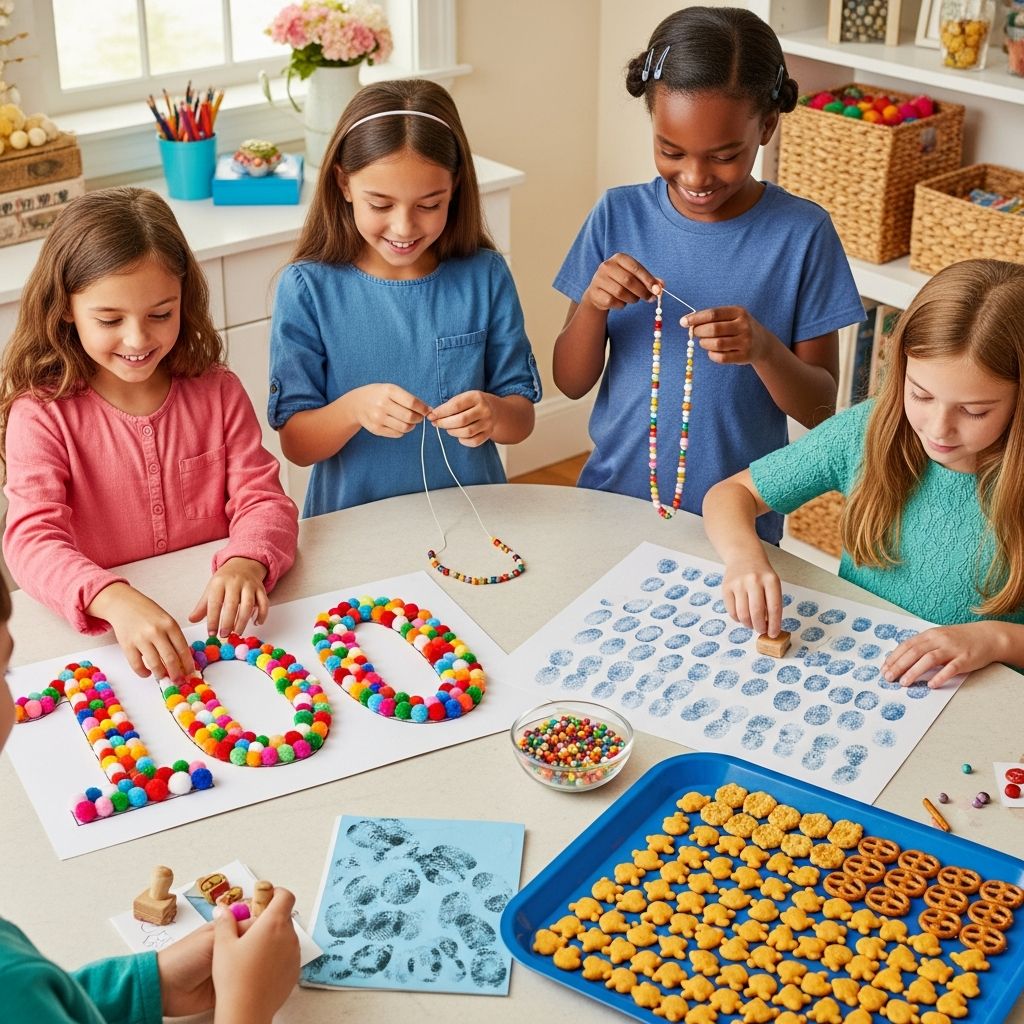
- Necklace or bracelet: String 100 beads, pasta shapes, or cereal loops, marking every 10 with a different color to highlight grouping.
2. Display Boards: Poster and Cardstock Projects
Poster-style projects are easy to carry, simple to store, and offer a clear surface to arrange 100 items in meaningful groups or patterns. This format works well for kids who like arranging and organizing.
- Picture collage of 100: Print or draw 100 small images related to a favorite theme, such as 100 foods, 100 sports balls, or 100 silly faces.
- Pattern grid: Divide the poster into 100 small squares and fill each box with a sticker, stamp, or doodle.
- “100 Words I Know” board: Have older kids write 100 different words they can read or spell, then decorate around them.
3. 3D Creations: Structures and Sculptures
Three-dimensional projects turn the number 100 into something that stands up on a desk or table. These are ideal for kids who like building and hands-on tinkering.
- Building blocks creation: Use 100 blocks, bricks, or interlocking pieces to create a tower, animal, or vehicle.
- Recycled materials sculpture: Combine bottle caps, cardboard tubes, and other clean recyclables, counting 100 pieces in total.
- Mini-world in a box: Decorate a shoebox with 100 small objects, such as toy figures, pebbles, paper shapes, or craft items.
4. Kindness and Community Projects
Not every 100th day project has to live on a poster or shirt. Some families prefer projects that emphasize kindness, gratitude, or connections with others, turning the celebration into a chance to give back.
- 100 kind words: Help your child list 100 positive words, such as compliments, character traits, or encouraging phrases.
- Gratitude notes: Write 100 small thank-you or appreciation notes and share them among teachers, staff, friends, or family.
- Acts of kindness tracker: Over a week or month, record 100 small kind actions and present them in a simple chart or booklet.
Age-Appropriate Project Ideas at a Glance
Different grade levels often require different levels of independence and complexity. The table below gives a quick overview of ideas that usually work well for common age groups, while still leaving room for modifications.
| Grade level | Typical goals | Sample project types |
|---|---|---|
| Pre-K & Kindergarten | Practice counting, fine motor skills, and simple patterns. | Sticker posters, cereal necklaces, simple collages, dot paintings. |
| Grades 1–2 | Group objects by tens, explain thinking, and add creativity. | Patterned shirts, theme-based posters, block structures, word boards. |
| Grades 3–4 | Connect 100 to stories, writing, or data. | “100 facts” collections, short stories, surveys with 100 responses, charts. |
| Grades 5 and up | Use 100 in more abstract or project-based ways. | Experiments repeated 100 times, 100-question quizzes, research lists. |
Working With What You Already Have at Home
One of the biggest sources of stress for parents is feeling pressured to buy a cart full of craft supplies. In reality, most 100th day projects can be made from everyday objects you have on hand. Looking creatively at your pantry and junk drawer often reveals more than enough material.
Common items that work well include:
- Buttons, stickers, paperclips, rubber bands, or clothespins
- Pasta shapes, dry beans, cereal pieces, or rice (if food projects are allowed)
- Magazine cutouts, old greeting cards, or catalog pictures
- Scrap paper, colored paper, sticky notes, or index cards
- Small nature items like leaves, pebbles, shells, or twigs (clean and dry)
Helping Without Taking Over the Project
One of the hardest parts of school projects is resisting the urge to make everything perfect. Teachers can easily tell when adults have done most of the work, and that takes away from what the child learns. Your goal is to support, guide, and ensure safety, not to produce a museum-quality display.
Try these strategies to keep the work child-led while still being helpful:
- Let your child decide the theme, even if it feels a little quirky.
- Offer choices instead of instructions (for example, “Do you want to glue or tape these?”).
- Handle tasks that require sharp tools or hot glue, while your child places and arranges the pieces.
- Encourage them to explain their thinking as they count and group.
- Accept that crooked lines and uneven spacing are signs of real learning.
Turning the Project Into a Learning Moment
While the finished product will go to school, the real value happens at your kitchen table. The conversation, the problem-solving, and the counting practice all help your child make sense of the number 100 and of their own growing abilities.
You can easily weave learning into the process by:
- Counting out loud together in ones and in groups of ten.
- Asking your child how many items they have left to reach 100.
- Comparing groups (for example, which pile looks larger, which is heavier).
- Talking about where they see the number 100 in daily life (money, distances, scores).
- Having them practice a short explanation of their project to build speaking skills.
Troubleshooting Common 100th Day Project Challenges
Even with a plan, things can go sideways: a project falls apart, glue will not dry, or your child suddenly changes their mind. Preparing for a few common problems keeps the experience calm and flexible instead of frustrating.
Here are simple backup strategies you can keep in mind:
- The items will not stay attached: Switch from glue sticks to stronger liquid glue or tape and give extra drying time.
- You run out of objects: Fill in remaining spaces with drawn or stamped shapes to reach 100.
- It is the night before: Choose a flat project like a list of 100 items, a quick collage, or a counted snack mix instead of a complex construction.
- Your child is frustrated: Suggest a short break, reset the goal, or simplify the design while keeping the “100” idea intact.
Sample Project Concepts You Can Adapt
To spark your imagination, here are several flexible project concepts. These are not scripts to copy exactly but starting points that you can tailor to what your child enjoys and to what you already have available.
- “100 Steps Around My World” poster: Take a walk and snap or draw quick pictures of things your child notices in roughly 100 steps. Print or sketch 100 small images and arrange them in a path on a poster.
- “If I Had 100…” drawing book: Fold paper into a mini-book. On each page, your child completes a prompt such as “If I had 100 pets…” or “If I had 100 dollars…,” with a sentence and picture until they reach a total of 100 doodles or objects across pages.
- “100 Things That Make Me Smile” collage: Cut words and images from magazines or draw small symbols representing things your child loves, counting until the board holds 100 separate elements.
- “Weather for 100 Days” chart: If you have records from earlier in the year, tally how many days were sunny, cloudy, or rainy up to 100 and present the data in a simple bar chart or pictograph.
- “100 Tiny Goals” chain: Write short, positive goals or habits on 100 paper strips and link them into a chain that can hang in the classroom or at home.
Frequently Asked Questions About 100th Day Projects
Do projects always have to use exactly 100 objects?
Most teachers expect the project to clearly connect to the number 100, but that does not always mean 100 separate items glued to a surface. It can be 10 groups of 10, a 100-word story, 100 minutes of reading logged, or a chart built from a total of 100 pieces of data. When in doubt, check the instructions or ask for clarification.
What if my child’s project looks simpler than others?
A simple, student-made project is more valuable than an elaborate display that an adult created. Teachers tend to appreciate authenticity, age-appropriate work, and visible effort more than perfection. If your child understands and can explain the “100” idea, the project is a success.
Can food be used in 100th day projects?
Food-based projects like counted snack mixes or cereal necklaces are popular, but not always allowed because of allergies or school policies. Always read the teacher’s directions and school guidelines carefully before using any edible items and label ingredients if required.
How much should I spend on supplies?
There is no need to spend much, or anything at all. Many memorable projects come from recycled materials, basic art supplies, or items from nature. Setting a modest budget—such as choosing to buy only one or two small items—can reduce pressure and encourage creativity.
What if we really do not have time?
Life happens. If you are short on time, choose a flat, fast project that relies on drawing, writing, or simple counting rather than complex construction. A list of 100 things, a quick collage, or a decorated paper with 100 shapes can still meet the goal and let your child participate in the classroom celebration.
The 100th day of school does not have to be a source of stress. With a bit of planning, a focus on your child’s interests, and a willingness to embrace imperfection, the experience can turn into a fun family memory and a powerful reminder that steady effort over time leads to big milestones. Let the project showcase your child’s personality, not your crafting skills, and enjoy watching them proudly carry their work into the classroom.