The 100th day of kindergarten is a perfect moment to pause, celebrate growth, and show children how much they have learned in just one hundred days. With thoughtful planning, this milestone can become a fun tradition that weaves together math, literacy, creativity, and family involvement. This guide shares original, classroom-ready ideas and at-home projects that help children feel proud, empowered, and excited about learning.
Why the 100th Day Matters in Kindergarten
Reaching 100 days of school gives young children a concrete way to understand a big number and see that small efforts add up over time. It also offers teachers and families an opportunity to recognize persistence, routines, and friendships that have developed since the first day. When celebrations stay playful and age-appropriate, this day can reinforce a love of school and a sense of community.
- It turns an abstract number into something children can touch, count, and create with.
- It encourages reflection on growth: “What can I do now that I couldn’t do on day one?”
- It provides a natural theme for math, writing, art, and even movement activities.
Planning a Low-Stress 100th Day Celebration
Celebrations do not need to be elaborate or expensive to be memorable. A simple plan, communicated clearly to families, can reduce stress and ensure the day runs smoothly. Think about your goals first—do you want to highlight counting, showcase creativity, or strengthen classroom connection? Then choose just a few projects that fit your priorities, rather than trying to do everything.
- Decide on 2–4 main activities that you know your class can complete in a typical school day.
- Offer optional at-home projects for families who love extra crafts, but keep classroom expectations manageable.
- Include calm, independent tasks (like coloring or simple writing) to balance high-energy games.
Sample 100th Day Schedule for Kindergarten
The table below shows one possible way to structure the day. Adjust times and activities based on your schedule, students’ energy levels, and school guidelines.
| Time | Activity | Focus Skill |
|---|---|---|
| Morning arrival | 100-piece welcome hunt (find and count 100 small items together) | Counting, cooperation |
| Morning circle | Read-aloud about growing and learning; discuss “100 days smarter” | Listening, speaking |
| Center time | Rotating 100th day centers (math, art, building, writing) | Fine motor, problem-solving |
| Before lunch | Movement break: 100 quick actions (10 sets of 10 exercises) | Gross motor, counting by tens |
| Afternoon | Show-and-tell of home projects and group class display | Speaking, confidence, community |
| Closing circle | Reflection drawing or sentence: “On the 100th day, I feel…” | Emotional awareness, early writing |
Classroom Math Projects with 100 Objects
Working with 100 small items is one of the clearest ways to help kindergarteners grasp this big milestone. Invite students to touch, sort, and arrange objects in different ways so they see that quantities can look different while still adding up to 100. Everyday materials like buttons, blocks, or stickers are all you need.
Hands-On Counting Collections
Create several “100 collections” around the room, each made from a single kind of item. Children can rotate between stations and compare how 100 buttons looks compared to 100 paper clips. This builds flexible thinking about quantity and encourages children to use counting strategies they have practiced all year.
- Use muffin tins, egg cartons, or snack trays with 10 spaces so children can place 10 in each space.
- Label containers with “10, 20, 30…” so students notice patterns while they work.
- Ask questions like “What happens if we move these 10 from here to there? Do we still have 100?”
100-Themed Math Centers
Set up a few math centers that encourage repeated practice in playful ways. These do not have to be complicated; even simple recording sheets paired with familiar manipulatives can take on new excitement when labeled “100th day center.” Choose activities that match your students’ current abilities.
- Roll-and-color to 100: Children roll a die and color that many squares on a 100 chart until it is full.
- Stamping or sticker paths: Students place 100 stamps or stickers along a path, then count by fives or tens.
- Build and measure: Build a 100-link chain or 100-cube tower and compare it to items in the classroom (Is it taller than a chair? Longer than a table?).
Creative Art and Craft Ideas for the 100th Day
Art projects help children express what “100” means to them visually. Aim for crafts that let each student make personal choices while still being simple to prepare and clean up. The goal is not perfection, but ownership and joy.
Design a “100 Wonders” Poster
Give each child a large sheet of paper divided into small sections or shapes. Their task is to fill the page with 100 small marks or decorations. Because the instructions are open-ended, the results feel genuinely creative while still meeting the math target.
- Children can use dots, stars, tiny drawings, or stickers—each one counts as a single item.
- Encourage them to group their marks in sets of ten so counting remains manageable.
- Display the posters together as a “Gallery of 100 Wonders” in the hallway or classroom.
Wearable 100th Day Art
Wearable projects make the celebration visible throughout the school day. These can be as simple as a paper badge or as involved as a decorated shirt, depending on how much time and family involvement you want. Lightweight materials are best so kids stay comfortable.
- Create “100 days brighter” crowns decorated with 100 dots, stickers, or jewels.
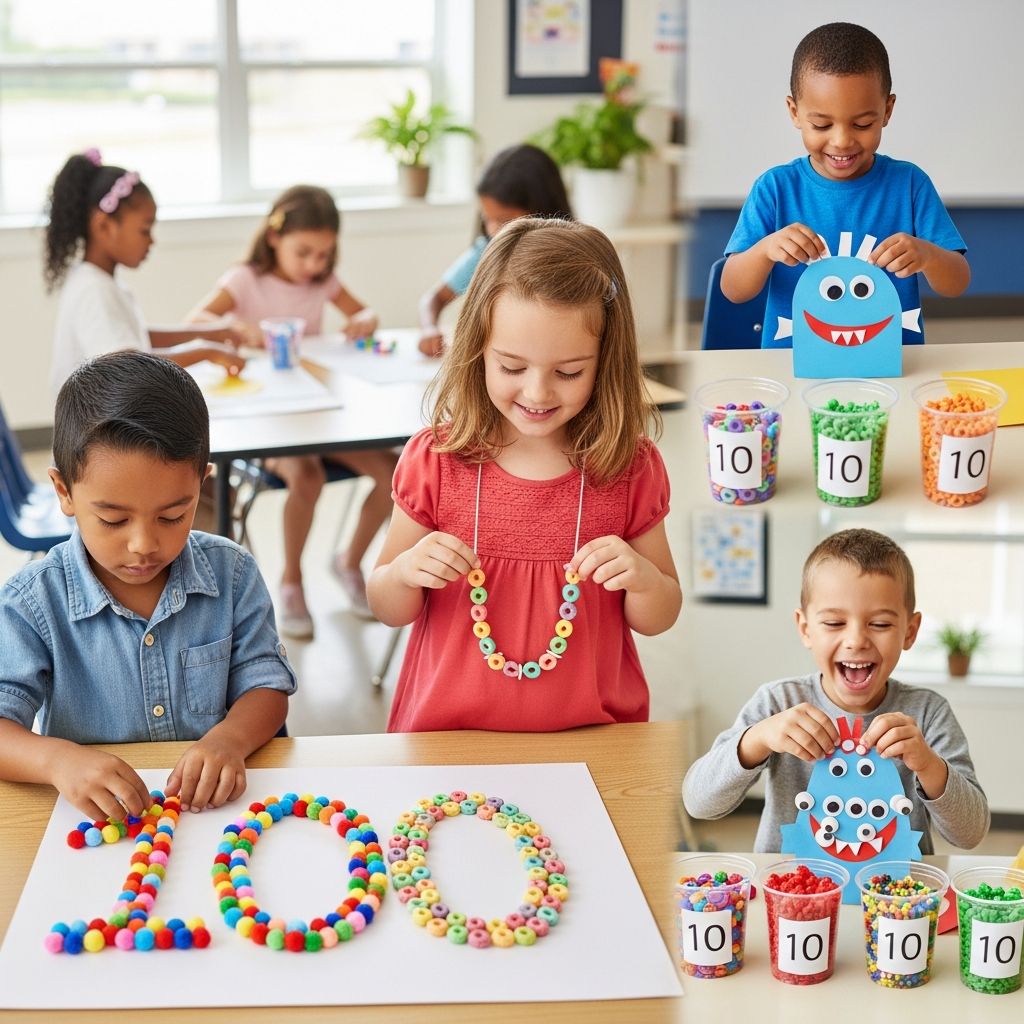
- Make simple paper necklaces using 100 beads or cereal pieces, strung in color patterns.
- Provide blank paper sashes for students to decorate with the number 100 and images of things they love about school.
STEM Building Challenges with 100 Pieces
STEM-style challenges connect the 100th day to engineering and problem-solving. Rather than focusing on right or wrong answers, emphasize experimentation. Children can test ideas, adjust their designs, and collaborate with peers in small groups.
“Reach for 100” Tower Challenge
Provide building materials and invite students to create the tallest structure they can using exactly 100 pieces. This could be cups, blocks, interlocking bricks, or recycled boxes. Encourage teams to talk through their plans before they begin building.
- Have groups count out their 100 pieces before starting to avoid running out or going over.
- Pause halfway through for a quick “engineer check-in” where teams share one challenge and one strategy.
- Take photos of finished towers and compare heights using nonstandard measurements (e.g., “Our tower is 6 books tall”).
Bridge or Pathway with 100 Steps
Another engaging option is to invite students to design a pathway, road, or bridge that uses 100 elements. Tape, paper strips, craft sticks, or cardboard tiles all work well for this type of project. Children can imagine that toy cars, animals, or dolls will travel along the path.
- Encourage students to test their pathway with small toys, checking for gaps or weak spots.
- Challenge them to arrange pieces so they can count by twos, fives, or tens as they move along the path.
- Turn finished paths into a classroom “city” by connecting them on the floor or on tables.
Language and Writing Activities Around the Number 100
The 100th day is also a powerful springboard for early writing and storytelling. Even emergent writers can contribute ideas through drawings, dictation, and shared writing experiences. The key is to use playful prompts that invite imagination rather than perfection.
“If I Had 100…” Prompt Collection
Invite each child to complete a sentence starter related to the number 100. Responses can be serious, silly, or somewhere in between. Later, bind them into a class book that students can reread during quiet time.
- Ideas for sentence starters include: “If I had 100 pets…,” “If I could eat 100 treats…,” or “If I could visit 100 places…”
- Students can draw their ideas and write a word or simple sentence underneath.
- Display a few responses on a bulletin board to celebrate creativity and humor.
100 Compliments for Our Classroom
Use the day as a chance to focus on kindness and community. Work together to generate 100 positive statements about the class, school, or individual classmates. This activity encourages children to notice and name strengths in themselves and others.
- Write student ideas on colorful paper shapes and arrange them in the shape of the number 100.
- Prompt children with questions like “What makes our class a good place to learn?” or “What makes a good friend?”
- Leave the display up as a long-lasting reminder of the supportive classroom culture.
Movement and Brain Breaks with a “100” Twist
Kindergarteners learn best when they can move frequently. Short, themed movement breaks keep students energized and focused throughout the celebration. These can be woven naturally between quieter projects like writing or crafts.
100 Moves in Short Bursts
Instead of doing 100 of the same action, break movement into manageable sets. Children can quickly experience what “100” feels like in their bodies while practicing counting skills. This is a great time to introduce simple skip counting.
- Do 10 sets of 10 different movements, such as jumps, toe touches, or arm circles.
- Have students count aloud together as they move, reinforcing one-to-one correspondence.
- Encourage children to notice when they feel tired and to listen to their bodies.
“Travel 100 Steps” Exploration
Estimate how far 100 steps will take the class and then test it together. This can be done indoors down a hallway or outside in a safe area. Children can make predictions before they walk and compare them to the actual experience.
- Mark the starting point with tape or chalk, then walk together while counting each step.
- Ask students if they think 100 tiny steps or 100 giant steps would go farther and why.
- Discuss how measurement and estimation help people in everyday life.
Family-Friendly 100th Day Projects
Many families enjoy contributing to 100th day celebrations, but not everyone has extra time or resources. Offer a range of optional projects that use common household items and do not require special supplies. Make it clear that participation is encouraged but not required so no child feels left out.
Simple At-Home Collection Projects
Ask children who are interested to collect and display 100 of something from home. Emphasize that the items should fit in a backpack and not be too valuable or fragile. Collections become excellent show-and-tell prompts on the big day.
- Examples include: paper clips, bottle caps, stickers, cotton balls, or toy cars.
- Families can sort the collection into groups of ten using snack bags, egg cartons, or small cups.
- Provide a simple label template where children can write or dictate a title for their collection.
Photo or Drawing Projects
Some families may prefer creative projects that do not involve gathering objects. Photo and drawing assignments allow for personal storytelling and can be easily shared with the class. Consider offering templates or examples in advance.
- Invite children to create a drawing showing themselves on the first day of school and on the 100th day.
- Ask families to send a photo of something that shows “100” in real life, such as a price tag, calendar, or sports jersey number.
- Create a class slideshow or wall display featuring the images and drawings.
Displaying and Celebrating Student Work
How projects are displayed can be just as meaningful as the activities themselves. Take time to showcase each child’s contribution in a way that feels respectful and celebratory. Invite students to walk around the room, admire each other’s work, and share compliments.
- Group projects by theme—math, art, writing—so families can see the full range of skills being practiced.
- Encourage students to choose one favorite piece and explain why it matters to them.
- Consider inviting another class or school staff to tour the “100th Day Museum” you have created.
Tips for Inclusive and Accessible Celebrations
Every child should feel successful and included on the 100th day of kindergarten. Anticipate areas where students might struggle, such as large-number counting or fine motor skills, and build in supports. Flexibility is more important than following any single plan perfectly.
- Allow children to work in pairs or small groups so they can help one another with counting and crafts.
- Offer alternatives for students who are sensitive to noise or crowds, such as quieter versions of games.
- Adapt projects for different abilities by varying the number of items, the size of materials, or the level of adult support.
Frequently Asked Questions About 100th Day Kindergarten Projects
How early should planning begin?
Many teachers begin planning a few weeks in advance so they can gather materials, inform families, and integrate related lessons into their math and literacy blocks. Even with limited time, a small set of well-chosen activities can make the day feel special.
Do all students need to bring a home project?
No. Home projects should always be optional so that families with limited time or resources are not placed under pressure. Classroom-based projects ensure every child participates in meaningful ways, regardless of what happens at home.
What if some children find counting to 100 difficult?
Use supports like ten frames, number lines, and peer partners to make counting more manageable. Focus on the process rather than perfection; children can still engage meaningfully even if they are not yet fully fluent with numbers up to 100.
How can the day stay academically meaningful?
Link each activity to a clear skill, such as counting by tens, organizing data, or expressing ideas in writing. When students are having fun while practicing important concepts, the celebration becomes both joyful and educational.
What is the main goal of the 100th day?
The main goal is to celebrate growth and persistence while helping children see that every school day contributes to their learning. With simple, thoughtful projects, the 100th day of kindergarten can become a cherished memory and a reminder that big achievements begin with small, consistent steps.